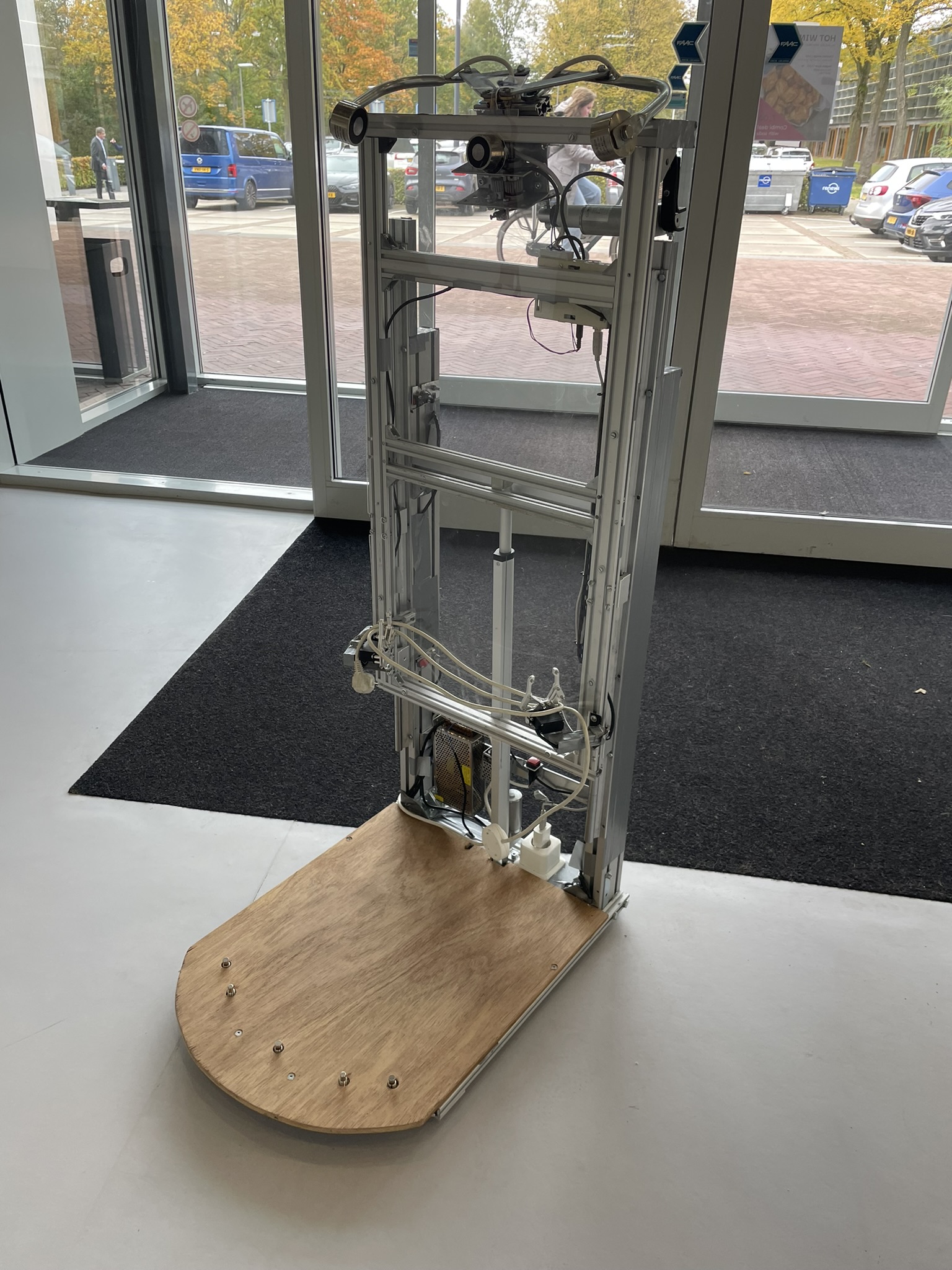
Assistive technologies are essential for improving the lives of people with disabilities, especially those with progressive conditions like ALS (Amyotrophic Lateral Sclerosis). ALS affects movement and independence, making everyday tasks more challenging for individuals and their families. This thesis explores the development and potential for small-scale production of such devices, focusing on the coat assistant created by the Kuiken family for their son, Sebastiaan, who could no longer go outside on his own because he was not able to put on his coat independently.
The coat assistant represents the growing trend of personalized assistive devices. With its motorized frame, magnetic attachments, and floor controls, the device allowed Sebastiaan to put on his coat without assistance, restoring his independence and autonomy. While the device has proven effective for Sebastiaan, challenges arise in bringing such personalized solutions to a broader audience. Regulatory barriers, high production costs and small target groups complicate the commercialization of these types of devices.
The Kuiken family initially attempted to bring the coat assistant to market but encountered difficulties due to regulations, the lack of design drawings, and the limited target audience. Undeterred, they reached out to Ability Tech, a company specializing in assistive devices. This thesis is done at Ability Tech and aims to explore ways to make such devices more widely available through small-scale production in FabLabs, which are maker spaces with digital tools for creating physical objects. It also looks at how the coat assistant can be adapted for different users and conditions.
This project is dedicated to Sebastiaan, whose life and struggle with ALS inspired the development of this device. Unfortunately he passed away during this project but the goal is to share his legacy. This is done by creating an accessible and scalable coat assistant that helps others with similar challenges.